
Friday, May 25, 2007
Thursday, May 10, 2007
Help our friends to the south.

May 6th 2007 is the begining of duck hunting season in New Zeland. This begs the question:
Where is the HOY7 hunting team?
Unfortunately we are not in New Zeland and only YOU can help. Send your tax deductible donations to us here at the HOY7HT so that we may cleanse the southern hemisphere of all the evil green haded bastards. Without your help our Kiwi friends will be ruthlessly slaughtered by this invasion of flying killers.
Don't delay, send money today!
GBCH

Thursday, April 26, 2007
Summer practice

Look at the form.
The flowing grace.
The fluidity of the shot.
All this can mean only one thing, it's golf time again. Now that hunting season is but a distant memory and the ducks all have their little brood to tender it is time to switch gears. The spring tour of the HOY7 hutning team has begun. In fine fashion too. The tours current leader is none other than Robert DaFolder, by a healthy margin of about 24 strokes or so. After a soggy round at the long playing Great Blue course I steped out to an early lead.
This week the tour moved to the historic Eastmoreland course (Once voted on of the best 40 public courses in the US. Now, who knows?) where we burned up the links again. I started strong but had a poor finish and allowed Fred G to creep back into the chase. After 15 it was all even but Fred's subtle mind game got the best of me and I "topped one into the water" giving him the lead. By the end of the day I was still on the top of the leader board and the money list but my domination is clearly slipping.
Let the games begin. And if you are asking just where the heck Mr. Chucker Sr. was in all this, keep in mind that we are too.
GBCH
Saturday, April 21, 2007
Spring news

Spring migration is in full swing for all waterfowl during April. Events happen fast this time of year. There is a limited opportunity to get nesting, brood rearing and molting done before its time to head south again. In fact, ducks spend less than 40 percent of the year on their breeding grounds.
Northern marshes usually begin to thaw in early April. This brings the first wave of pintails and mallards onto the U.S. and Canadian prairies. They either congregate on these thawed wetlands or stand on the ice waiting for it to melt. Many begin nesting within the first week of arrival.
Impressive numbers of snow geese fly over the prairies on the way to their breeding grounds. They move north as rapidly melting snow unearths food and melting ice provides drinking water.
By the second week of April, northern shovelers and green-winged teal arrive just as pintails and mallards begin nesting. On the Atlantic coast, peak egg laying occurs in black ducks the second week of April.
Mid-April brings the main flight of migrant Canada geese - including members of the Richardson’s and lesser subspecies – to the Dakotas and Great Lake states. Interior subspecies of Canada geese arrive along the southwest coast of St. James Bay in mid-April. And farther north on the Slave River Delta, they arrive during the last week of April. At the same time, sub-arctic nesting geese are migrating north, and Giant Canada geese in the Midwest and southern latitudes are on the nest beginning incubation.
By the third week of April redheads, canvasbacks, ring-necked ducks and lesser scaup will arrive and begin their high-speed aerial courtship dances. Gadwalls are arriving on the prairies, too.
While March’s unseasonable warmth made it look like winter was long gone, a heavy snowfall like recently occurred in the northern states, or blast of cold Canadian air, stops the migrants in their tracks and occasionally sends them retreating south.

Thursday, March 22, 2007
Memories.

Boy, I sure looked good in that jacket.
I wonder if my next jacket will be that warm?
I hope that my next jacket has lots of pockets.
Maybe I will get a jacket and waders that match.
Man, that was a good jacket.
Things we know because we are the BEST.
Weather conditions have an enormous influence on duck hunting success. To make the most of their days afield, waterfowlers must understand weather patterns and how they affect bird behavior.
Foul weather, for instance, is usually considered a duck hunter's greatest blessing. But to be consistently successful, even under these favorable conditions, a hunter must know how storm fronts influence ducks. On the flip side of the coin, sunny "bluebird" days are considered a duck hunter's bane. Yet the hunter who knows how fair-weather conditions affect duck behavior will often bring home a limit.
Sunny, cloudy, windy, calm, freezing, warm -- let's focus on conditions waterfowlers often encounter and some tips for hunting ducks successfully no matter what the forecast.
Storms
A low-pressure system in the weather forecast indicates rain is on the way -- bad news for most, but not for the duck hunter. Along with a stiffening wind, storm fronts increase cloud cover. Ducks stop feeding at night and move more early and late in the day. There's no glare off gun barrels and upturned faces, and no distinguishing shadows to reveal the silhouette of a waiting hunter. The hunting picture begins to improve.
As winds intensify, ducks move to protected areas -- river backwaters, lake coves, green-timber openings, the lee side of islands. Rain and/or sleet intensifies their scramble for shelter, limiting and defining the places they are likely to be. More and more birds move into fewer and fewer areas. The savvy hunter is a step ahead of them, setting out decoys and preparing to shortstop their weather-driven migration.
Low pressure in the forecast indicates rain is on the way -- bad news for most, but not for avid waterfowlers. Changing winds also work in the hunter's favor. In our part of the world, they usually begin in the south, then blow round the compass--southeast, east, northeast, north, then finally northwest--as the low is replaced by a high-pressure, fair-weather system. Sanctuaries at the onset of the storm lose their protection as it progresses. Ducks settle into one lee then are forced to find another. They fly throughout the day and lose much of their cussed wariness. Most fly low as they work the slower air near ground. In the right place at such a time, a hunter with a few decoys is sure to find a bit of duck-hunting heaven.
As the weather changes, the successful duck hunter remains mobile, adapting to changing winds and changing lees. A well-camouflaged duck boat is a special asset now, providing easy access to every inch of shoreline, transportation for the hunter and his equipment, and a ready-made blind that melts into the landscape. If water isn't too deep, chest waders serve the same purpose. Moving from place to place, you can hunker down in a wet marsh or stand by a cypress without getting wet. A waterproof parka and gloves complete your weather-proofing, keeping you warm and dry.
Fair Skies
Clear, warm, windless days can make duck hunting tough. Ducks can now fly and raft, dabble or dive anywhere they please. Direct sunlight makes upturned faces glow with electric intensity. Even a perfectly camouflaged duck hunter is often revealed by the outline of shadows, and the slightest movement stands out like black on white. If the weather pattern holds for several days, birds quickly learn hunter patterns--where they like to hide, when they like to gun, and where the safe zones are.
In this situation, remember that ducks may come and go where they please, but they never do it at random. The flight lanes they establish, the fields and woods they feed in, the places they raft are purposely chosen, usually because they offer respite from hunter disturbance. By patterning the movements of birds in your area, you can overcome the disadvantages of blue-sky hunting.
The best way to do this is to simply go duck hunting. Set out a few decoys in a place you've chosen to the best of your hunting ability, then watch the comings and goings of birds throughout the day. Resolve to stay put, even if shooting isn't good. Note the time the ducks start flying and the routes they follow; the places where they fly high and fly low; the time they return; and the places they raft up. Once you've determined their flight, feeding and resting patterns, you can position yourself to intercept on future hunts.
Knowing how ducks will act in a variety of weather situations is the key to consistent success.
Freezing Weather
Extreme cold is both a blessing and bane. When shallows ice over, ducks concentrate in remaining areas of open water. Caloric intake must increase to compensate for lower temperatures, so twice-daily feeding becomes the norm. At temperatures below 20 degrees, you'll start noticing afternoon feeding flights in addition to the usual predawn movements. Unfortunately, freezing weather also makes boat travel more difficult and tests one's ability to withstand winter's cold. Hunters must cope with the frigid temperatures in order to be successful.
Part of that coping is knowing where water will be open in freezing temperatures. This may be in the main body of a creek or river where currents prevent ice-up; in a sheltered backwater area protected by levees or high banks; or in shallow green-timber flats that receive some current from adjacent streams.
One area I often hunt is in the bend of a small bayou. When the water's up, it runs across the inside bend of timber. This creates a three-acre sanctuary of unfrozen water right in the middle of the frozen pin-oak bottoms. During winter's worst weather, it's wall-to-wall ducks.
Most avid hunters work unfrozen river channels during frigid weather. They boat the river until they scare up a flock of ducks, then they move in and set up where the ducks flushed. Often, decoys are set in strings at the edge of willows, high banks and other sheltered spots. The boat is hidden in cover with a camouflage net stretched over it. The hunters stand in waders next to trees. The ducks they flushed will soon return, and when they do, the fun begins.
Snowstorms & Fog
When visibility is limited by fog or heavy snow, callers have a field day. In this situation, it pays to keep your call sounding whether you see ducks or not. Poor visibility may keep most ducks grounded, but those that are caught en route automatically set their flaps and start listening for friendly calls. Few duck hunting moments are as exciting as hearing unseen mallards answering a call in fog.
Snow Cover
Cold alone won't drive ducks from an area where food is plentiful, but if snow gets several inches deep or becomes glazed with ice, ducks must move elsewhere to find their groceries.
Here again, it pays to know where ducks are likely to go when conditions get bad. If woods remain open and acorns are plentiful, ducks accustomed to feeding in fields may gather in flooded timber when snow piles up. Cornfields are so attractive, they may continue drawing dense concentrations of birds even when blanketed with snow. Hunting diving ducks like scaup and buffleheads often remains productive even though mallards and other dabblers have been forced to move out.
The smart waterfowler matches hunting tactics to the weather throughout the season. By applying scouting techniques and a little reasoning about duck behavior, he develops an instinct for determining where and how to hunt no matter what's going on outside. Blue skies or gray, the odds are in his favor.
Foul weather, for instance, is usually considered a duck hunter's greatest blessing. But to be consistently successful, even under these favorable conditions, a hunter must know how storm fronts influence ducks. On the flip side of the coin, sunny "bluebird" days are considered a duck hunter's bane. Yet the hunter who knows how fair-weather conditions affect duck behavior will often bring home a limit.
Sunny, cloudy, windy, calm, freezing, warm -- let's focus on conditions waterfowlers often encounter and some tips for hunting ducks successfully no matter what the forecast.
Storms
A low-pressure system in the weather forecast indicates rain is on the way -- bad news for most, but not for the duck hunter. Along with a stiffening wind, storm fronts increase cloud cover. Ducks stop feeding at night and move more early and late in the day. There's no glare off gun barrels and upturned faces, and no distinguishing shadows to reveal the silhouette of a waiting hunter. The hunting picture begins to improve.
As winds intensify, ducks move to protected areas -- river backwaters, lake coves, green-timber openings, the lee side of islands. Rain and/or sleet intensifies their scramble for shelter, limiting and defining the places they are likely to be. More and more birds move into fewer and fewer areas. The savvy hunter is a step ahead of them, setting out decoys and preparing to shortstop their weather-driven migration.
Low pressure in the forecast indicates rain is on the way -- bad news for most, but not for avid waterfowlers. Changing winds also work in the hunter's favor. In our part of the world, they usually begin in the south, then blow round the compass--southeast, east, northeast, north, then finally northwest--as the low is replaced by a high-pressure, fair-weather system. Sanctuaries at the onset of the storm lose their protection as it progresses. Ducks settle into one lee then are forced to find another. They fly throughout the day and lose much of their cussed wariness. Most fly low as they work the slower air near ground. In the right place at such a time, a hunter with a few decoys is sure to find a bit of duck-hunting heaven.
As the weather changes, the successful duck hunter remains mobile, adapting to changing winds and changing lees. A well-camouflaged duck boat is a special asset now, providing easy access to every inch of shoreline, transportation for the hunter and his equipment, and a ready-made blind that melts into the landscape. If water isn't too deep, chest waders serve the same purpose. Moving from place to place, you can hunker down in a wet marsh or stand by a cypress without getting wet. A waterproof parka and gloves complete your weather-proofing, keeping you warm and dry.
Fair Skies
Clear, warm, windless days can make duck hunting tough. Ducks can now fly and raft, dabble or dive anywhere they please. Direct sunlight makes upturned faces glow with electric intensity. Even a perfectly camouflaged duck hunter is often revealed by the outline of shadows, and the slightest movement stands out like black on white. If the weather pattern holds for several days, birds quickly learn hunter patterns--where they like to hide, when they like to gun, and where the safe zones are.
In this situation, remember that ducks may come and go where they please, but they never do it at random. The flight lanes they establish, the fields and woods they feed in, the places they raft are purposely chosen, usually because they offer respite from hunter disturbance. By patterning the movements of birds in your area, you can overcome the disadvantages of blue-sky hunting.
The best way to do this is to simply go duck hunting. Set out a few decoys in a place you've chosen to the best of your hunting ability, then watch the comings and goings of birds throughout the day. Resolve to stay put, even if shooting isn't good. Note the time the ducks start flying and the routes they follow; the places where they fly high and fly low; the time they return; and the places they raft up. Once you've determined their flight, feeding and resting patterns, you can position yourself to intercept on future hunts.
Knowing how ducks will act in a variety of weather situations is the key to consistent success.
Freezing Weather
Extreme cold is both a blessing and bane. When shallows ice over, ducks concentrate in remaining areas of open water. Caloric intake must increase to compensate for lower temperatures, so twice-daily feeding becomes the norm. At temperatures below 20 degrees, you'll start noticing afternoon feeding flights in addition to the usual predawn movements. Unfortunately, freezing weather also makes boat travel more difficult and tests one's ability to withstand winter's cold. Hunters must cope with the frigid temperatures in order to be successful.
Part of that coping is knowing where water will be open in freezing temperatures. This may be in the main body of a creek or river where currents prevent ice-up; in a sheltered backwater area protected by levees or high banks; or in shallow green-timber flats that receive some current from adjacent streams.
One area I often hunt is in the bend of a small bayou. When the water's up, it runs across the inside bend of timber. This creates a three-acre sanctuary of unfrozen water right in the middle of the frozen pin-oak bottoms. During winter's worst weather, it's wall-to-wall ducks.
Most avid hunters work unfrozen river channels during frigid weather. They boat the river until they scare up a flock of ducks, then they move in and set up where the ducks flushed. Often, decoys are set in strings at the edge of willows, high banks and other sheltered spots. The boat is hidden in cover with a camouflage net stretched over it. The hunters stand in waders next to trees. The ducks they flushed will soon return, and when they do, the fun begins.
Snowstorms & Fog
When visibility is limited by fog or heavy snow, callers have a field day. In this situation, it pays to keep your call sounding whether you see ducks or not. Poor visibility may keep most ducks grounded, but those that are caught en route automatically set their flaps and start listening for friendly calls. Few duck hunting moments are as exciting as hearing unseen mallards answering a call in fog.
Snow Cover
Cold alone won't drive ducks from an area where food is plentiful, but if snow gets several inches deep or becomes glazed with ice, ducks must move elsewhere to find their groceries.
Here again, it pays to know where ducks are likely to go when conditions get bad. If woods remain open and acorns are plentiful, ducks accustomed to feeding in fields may gather in flooded timber when snow piles up. Cornfields are so attractive, they may continue drawing dense concentrations of birds even when blanketed with snow. Hunting diving ducks like scaup and buffleheads often remains productive even though mallards and other dabblers have been forced to move out.
The smart waterfowler matches hunting tactics to the weather throughout the season. By applying scouting techniques and a little reasoning about duck behavior, he develops an instinct for determining where and how to hunt no matter what's going on outside. Blue skies or gray, the odds are in his favor.
Friday, March 16, 2007

Tuesday, March 13, 2007
Journal of 2005 - 2006 Duck Season.
Day 1. 4:00 am. Woke up this morning with the promise of a wonderfull begining to the new season. Overcast and a little chilly, not a bad day for this early.5:00 am. Picked up Fred with enough time to get to Sauvies Island and get in line for the lottery to pick the best blinds for the day. Fred does a great job of picking a low number and we go to the warden to try a new spot.5:35 am. Warden informs us that Fred has brought the wrong licence. Although he's already purchaced the correct one, it's back at his house. (25 min away)6:30 am. After a visit to the lacal 7-11 to try to buy another licence, (the machine was broken) we're back at Freds to get the right licence. Resist urge to leave him there as we are a team after all.7:25 am. We are now all set up at the old shitty Lewis and Clark spot of previous years. Conversation resumes.7:30 am to 2:30 pm. Wait for ducks.2:31 pm. Go home. Well there you have it. The first day of the season and we are off to a roiusing start.
Fortunately for us lessons were learned and today (wed) was much better. Fred shot the first Greenie of the year and made a cool $10 in the process. I missed 8 ducks 5 times because I'm sure my gun is bent or something, not to worry, I'll be getting a new gun soon and all my problems will be solved. Remember it's allways the arrow, not the Indian. Speaking of new guns I've been lusting over the new Benelli nova pump shotgun for almost a year now. Finally I've got the many layers of approval I need to get one and I'm very excited. I should be able to pick it up next Sunday. Then, this morning, my best pal shows up with the Benelli Super Black Eagle semi auto full crumbler. He even let me hold it. Hey, what are best friends for. That's it for this installment of the new season of hunting. Maybe in the future we will have some photos to go with the text. Hope you enjoyed it.
God bless Charlton Heston.
Monday, March 12, 2007
Be a STAR.
So here's the story.
My camera is gone. Someone else has my most recent pictures of all the things I do after hunting season. (I hope they choke on them by the way.) Because of this I have no pictures of anything to post to the Blog and as we all know, pics say a thousand words. The way I see it there are three options for those of you who read the blog on a daily basis.
A. Send me a new digital camera or money for a new digital camera. A nice one too.
2. Send me some pictures that you may have so that I may use them and make YOU a STAR.
d. Expect only text. Maybe just some updates on things I find in the driveway or what I watched on my 4 channels of tv last night.
Don't delay, act today!
GBCH
My camera is gone. Someone else has my most recent pictures of all the things I do after hunting season. (I hope they choke on them by the way.) Because of this I have no pictures of anything to post to the Blog and as we all know, pics say a thousand words. The way I see it there are three options for those of you who read the blog on a daily basis.
A. Send me a new digital camera or money for a new digital camera. A nice one too.
2. Send me some pictures that you may have so that I may use them and make YOU a STAR.
d. Expect only text. Maybe just some updates on things I find in the driveway or what I watched on my 4 channels of tv last night.
Don't delay, act today!
GBCH
Thursday, March 08, 2007

Monday, March 05, 2007
Mystery solved.
 Been wondering just where the heck Fred G has been? Wonder no further. After winning the 120 Million powerball jackpot it seems Fred left the country for a little R & R in the sunny Bahamas. While there he is enjoying the sun and cocktails at the Four Seasons and finally getting that tan he so deserves. Of course he left me here by myself to look after the blog. That is why you never see any posts from Fred anymore. He just dosen't have the time for it. Don't worry though, I'll continue to bring you periodic updates and snippets of news from the HOY7 hunting team and beyond. And anyway, the important thing is that Fred is OK. GBCH.
Thursday, March 01, 2007
Crazy Andy, where is he now?
Hello From thailand!
I hope things are going well.
Kevin and I traveled from the beach in Cambodia....after I got a 24 hour bug(wheww-bad one) to the capitol, Phnom Phen, for one day and then further north to Kratie, where we saw the Irawaddy dolphins in the Mekong River. Then an ardous trip to the remote border crossing of Cambodia/Laos by bus, boat, bus, boat to the 4000 islands of Laos.
This was really nice...very peacful place and nice to just swim in the Mekong or see the nearby waterfalls. By this time..... we were up to 5 of us...... with the addition of a couple from us/germany and a girl from switzerland. I was on a rope swing and managed to sprain my ankle and that put me out of commision for a couple of days.
We went further up into laos and to a temple in Champosak and then to the Bolevan Highlands where we went elephant riding and saw more waterfalls...staying in a little bungelow with pigs, chickens, geese, dogs, cats and animals i'm sure i have forgotten.
I managed to get the bug again there....but not as bad....3 out of the 6 of us got the bug.
I left this morning for the border of Thailand and now I'm just over the border waiting for a night train to bangkok. It leaves in several hours for the 12 hour journey(6pm to 6am).
I hope your all doing well and I should be home on march 1st!
andy
I hope things are going well.
Kevin and I traveled from the beach in Cambodia....after I got a 24 hour bug(wheww-bad one) to the capitol, Phnom Phen, for one day and then further north to Kratie, where we saw the Irawaddy dolphins in the Mekong River. Then an ardous trip to the remote border crossing of Cambodia/Laos by bus, boat, bus, boat to the 4000 islands of Laos.
This was really nice...very peacful place and nice to just swim in the Mekong or see the nearby waterfalls. By this time..... we were up to 5 of us...... with the addition of a couple from us/germany and a girl from switzerland. I was on a rope swing and managed to sprain my ankle and that put me out of commision for a couple of days.
We went further up into laos and to a temple in Champosak and then to the Bolevan Highlands where we went elephant riding and saw more waterfalls...staying in a little bungelow with pigs, chickens, geese, dogs, cats and animals i'm sure i have forgotten.
I managed to get the bug again there....but not as bad....3 out of the 6 of us got the bug.
I left this morning for the border of Thailand and now I'm just over the border waiting for a night train to bangkok. It leaves in several hours for the 12 hour journey(6pm to 6am).
I hope your all doing well and I should be home on march 1st!
andy
Monday, February 26, 2007
Still no hunting.

So I went to the mountain again last week. The snow was so good that I decided to snowboard instead of ski. About a foot and a half of fresh new "powder", it is Oregon after all. And we were treated to the most rare of all Pacific Northwest ski day happenings; Blue Skies.
The picture here is from when I could actually snowboard like I was a young guy because I was, in reality, a young guy. Now I am old and can't do this kind of move anymore. The mind remembers, the body forgot. A couple days and some Flexerall later and I'm as good as new.
Only 2 hundred and some odd days till hunting season.
GBCH
Saturday, February 24, 2007

Tuesday, February 20, 2007
There's nothing like a good truck.

1995 GMC Sierra 1500 SLE with the Z-71 offroad package.
5.7l V-8
All power options
Topper
Tow package
Runs & looks great.
Who in their right mind would get rid of such a good hunting rig?
What now ?
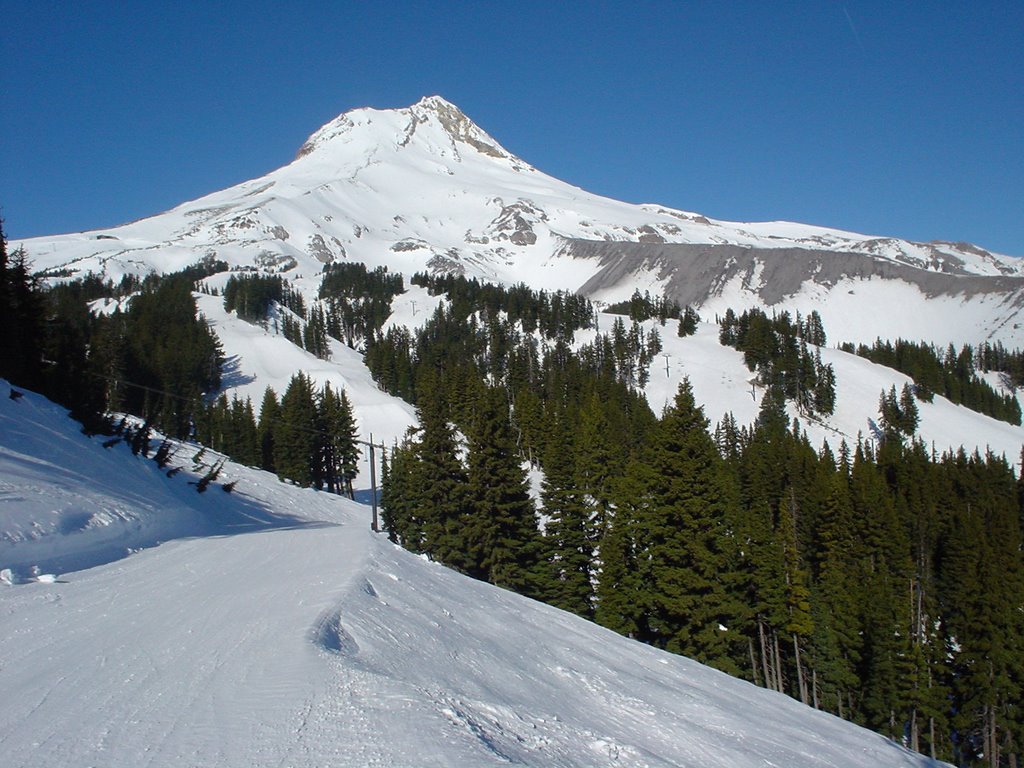
So today I went skiing at Mt. Hood. I'm sure you have been hearing about Mt. Hood because stupid people have been getting lost up there for the past few months. Not wanting to get lost I decided to not try to climb to the very top in the middle of a whiteout snowstorm but instead just went skiing. The photo shows what I would have been looking at if it weren't for the 12" of fresh that was cloging my goggles on every turn. Tomorow I'm going snowboarding instead. Still, it's not hunting. Nobody made lunch and there was no wikki next to my chairlift. Only about 225 day to go untill next season. GBCH.
Sunday, February 18, 2007
They can't run from the Benelli

LONDON: Webbed feet run in Stumpy's family, but he's the first to have four of them.
A rare mutation has left the eight-day-old duckling with two nearly full-sized legs behind the two he runs on. Nicky Janaway, a duck farmer in New Forest, Hampshire, 95 miles (150 kilometers) southwest of London, unveiled the duckling to reporters on Saturday.
"It was absolutely bizarre. I was thinking 'he's got too many legs' and I kept counting 'one, two, three, four,'" Janaway said.
Stumpy would probably not survive in the wild, but Janaway, who runs the Warrawee Duck Farm in New Forest says he is doing well.
"He's eating and surviving so far and he is running about with those extra legs acting like stabilizers," Janaway said.
Friday, February 09, 2007

Subscribe to:
Posts (Atom)


